Much of the abuse aimed at Afghan women online stays up because the systems built to remove it cannot fully read it.
The previous entry in this series examined what online hate speech costs Afghan women: deleted accounts, abandoned work, and voices withdrawn from public life. That raises an obvious question. If platforms prohibit harassment and hate speech, why does so much of it remain visible? A large part of the answer is language. Most of the abuse is written in Dari and Pashto, and the tools that police social media were not built with those languages in mind.
How Moderation Works
Platforms remove harmful posts through two layers: automated systems that scan content at scale, and human reviewers who handle what the machines flag or users report.
Both layers were designed first for English and a handful of priority markets. Leaked Facebook documents from 2021 showed the company sorted countries into tiers. The United States, Brazil, and India received dedicated resources such as election “war rooms,” while most of the world received far less.
Automated systems learn to recognize abuse from large sets of labeled examples. Where those examples are scarce, as they are for Dari and Pashto, the systems make more mistakes. They miss abuse that should be removed, and they remove posts that should stay up.
Where Dari and Pashto Fall Through
A 2022 study by Meedan and Pakistan’s Digital Rights Foundation, focused on Pashto and Dari content after the Taliban takeover, concluded that automated systems were poor at catching hate speech and false information in both languages. Four problems stand out.
- Too little training data. The researchers noted that detection algorithms are unlikely to be trained on Pashto and Dari as thoroughly as on English. More errors follow in both directions.
- No fixed spelling. When users write these languages in Latin letters instead of their own script, there is no standard spelling. One insult can appear in many variations, which defeats keyword filters.
- Context is everything. The researchers, all native speakers living in the region, could often judge whether a post was hateful only after reading its comments and the page’s history. A machine scanning single posts cannot do that.
- Small accounts escape. Viral posts and posts from established media outlets were most likely to be removed. Violating content from smaller, unverified pages was more likely to stay up.
X
X, where much of the documented abuse of Afghan women takes place, cut deeply into the teams responsible for catching it.
In January 2024, Australia’s eSafety Commissioner published figures X Corp. was legally required to provide about its trust and safety work since the October 2022 acquisition:
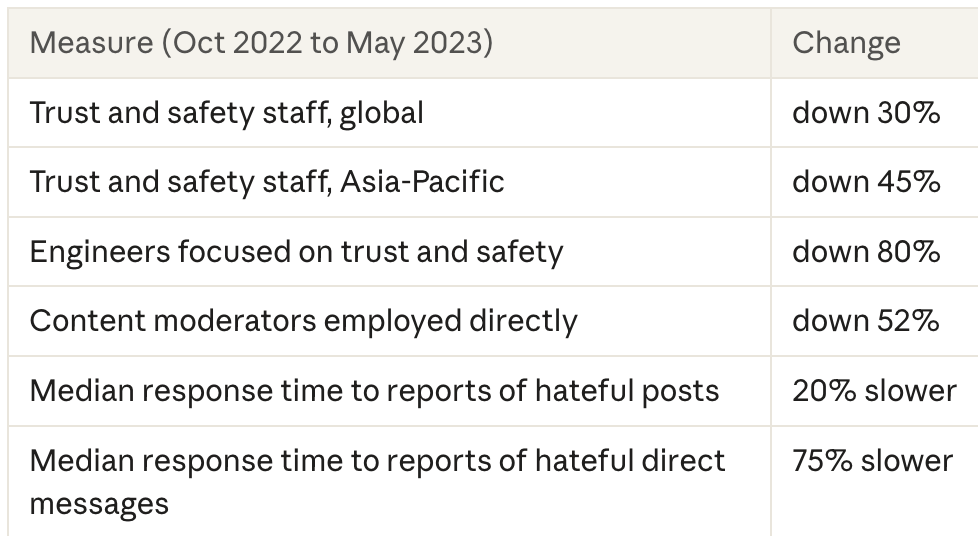
Two further findings fit the Afghan case closely. X stated it had no tools specifically designed to detect pile-ons, the coordinated swarms of abuse described above. And it relies solely on user reports to find hateful conduct in direct messages, where many Afghan women say the worst threats arrive.
Put together, the burden falls on the women themselves. They must report each message, often in a language the reviewer may not read, and then wait. Earlier entries in this series showed how many give up instead.
Possible Solution?
Researchers and advocates largely agree on the fix: more investment in the languages and people platforms have neglected.
- Invest in minority languages and dialects. Afghan Witness has urged platforms to revise their hate speech policies and build detection that works in minority languages and regional dialects.
- Rely less on automation, more on people. The Meedan and Digital Rights Foundation study called for more human moderators in non-Western contexts, with fair pay and protection from the trauma the work causes.
- Recognize unpaid labor. The same study noted that activists and ordinary users often do the flagging and escalating that automated systems fail to do. For Afghan women, that means the targets of abuse are also doing the cleanup.
- Open the books. Advocates have asked platforms to publish how they handle reports in each language, including what they decline to act on and why.
None of these is technically out of reach. Platforms have built dedicated teams before: after August 2021, Meta said it had native Dari and Pashto speakers monitoring Taliban-related content. The question is whether the same attention will be given to the women the Taliban’s supporters target online.
Closing
The moderation gap is not a glitch. It is the result of choices about which languages, and which users, are worth the cost of protecting. Until those choices change, Afghan women will keep writing in a language the platforms barely read, and the abuse aimed at them will keep standing.
The next entry in this series will ask who is targeted most: journalists, activists, athletes, and students each face different patterns of attack, and the differences say a great deal about what the abusers fear.


Leave a Reply